
Employee spotlight: How Cece Bigner, CostQuest’s third hire, helped build the operational foundation behind 21 years of company growth
When Mary “Cece” Bigner joined CostQuest in September 2004, she was one of the company’s first hires, arriving when the entire office consisted of just five or six people. Twenty-one years later, as she retires from her role as Lead Analyst in the modeling group, her fingerprints remain on nearly every system, process, and tradition that has helped the company grow into what it is today.
Hired for flexibility, not a job title
In a company’s earliest days, there’s rarely a clean job description of what needs to get done – only a need for someone willing to wear every hat. As Mark Guttman, VP and Chief Government Solutions Officer, recalls, “When we were that small, it was really about the phrase we used was like, Jack of all trades…we were looking for somebody who might be able to do a little bit of programming. We were also looking for somebody who could help do the production side of the work that we had to do.”
That was the job Cece stepped into fresh out of earning her degree in computer information systems. Jim Stegeman, CostQuest’s President and CEO, remembers her early responsibilities clearly: “She came out and we employed her to actually develop some small apps for us initially and to provide support, customer support, and really help us run our models at that point in time.” From there, her role kept expanding to meet whatever the company needed next, including helping run CostQuest’s first three industry conferences, where she played a key part in organizing logistics and welcoming attendees.
Becoming the backbone of production
As CostQuest’s work scaled, running national cost models for clients including the FCC, so did the operational demands underneath it. Mark describes just how dramatically that scale grew: “We used to think running on three computers was hard. Now…we’ve had 30, 40 operating nodes at a given time. And that’s just a lot to keep track of. So just how do you organize that army and keep that army processing?”
Cece became the person who did. Jim describes her production role in detail: “She had, I think, upwards of 10 to 15 different machines…she will kick off a state or an area on 15 different machines, and she’s monitoring, pulling the output from that, aggregating it, and ship it off to the next part of the process.” It required precision under pressure. Jim notes she “knows when there’s an issue, she can help us track down some of those issues…she’s always looking to make sure the output that we provide is high quality, and that we don’t have that mistake that we find three months later that we have to rerun stuff.”
Beyond running the models, Cece also built the infrastructure for the company’s institutional memory. “I felt like I worked up a pretty good system of naming conventions for the data archiving, keeping track of which model iteration was a final iteration,” she explains. “So that if we needed something in a few years…that was run a few years ago, I can find it. And leaving, I feel like the system is in pretty good place that everybody else can find it as well.”
The reliability the company was built on
Ask Jim to sum up Cece’s value in a sentence, and he doesn’t hesitate: “It’s that interchangeable cog that if something comes up, we can say, ‘Cece, would you be able to do this?’ And she’d say, ‘Yeah, I may not know, but I’ll learn how to do it and get it done.’” That reliability showed up most when it mattered most: under deadline pressure. “She is that cog that when we’ve got tight timelines, she’ll monitor, she’ll run. She is there until it’s done to make sure we get it out on time,” Jim says. “You can reach out to Cece to say, hey, can you help us get this done? And she will bend over backwards to help.”
Mark saw the same quality up close as the company reorganized around her over two decades: “Cece’s always been very kind of gracious in saying, okay, I’ll move on to this and I’ll keep this. She’s been very good at kind of going with the direction of the company and the change of the company.”
A culture worth staying for
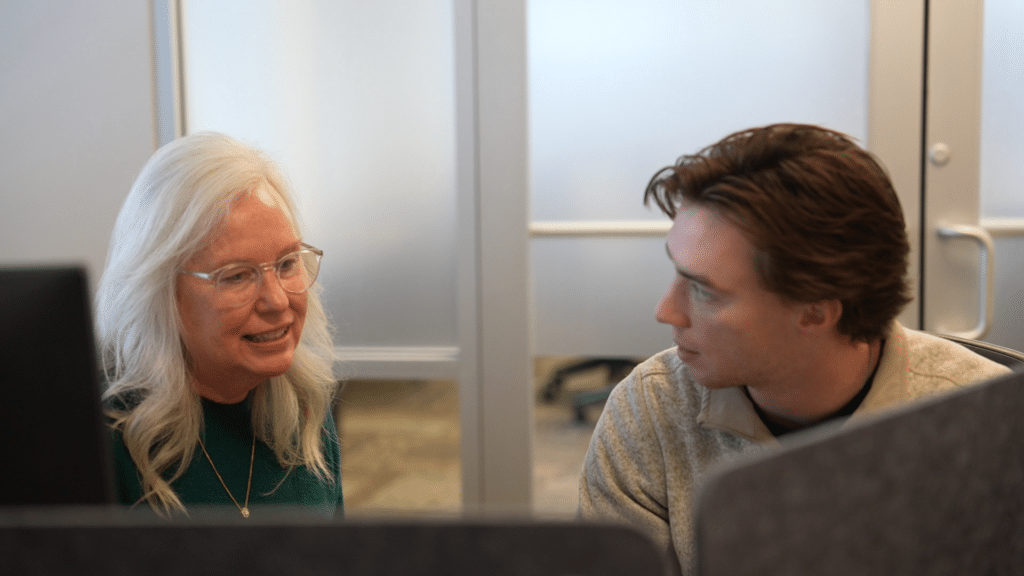
Cece’s 21 years of steady, dependable work became, in a real sense, part of CostQuest’s growth strategy. Low turnover isn’t an accident – it’s a signal. “I think that helps in retaining good people,” she reflects, “because they’re like, wow, this must be a good place to work…there’s virtually no turnover. So I feel like in that respect, that definitely has helped in the growth of the company.”
Jim frames her broader significance to the organization simply: “She’s just that type of person that is instrumental in an organization if you really want to survive and thrive, because you need those people to help fill all the roles of what needs to be done.”
Whether writing CostQuest’s early applications, running national production pipelines across dozens of machines, organizing the company’s first conferences, or building the data systems still in use today, Cece Bigner didn’t just witness CostQuest’s growth from five employees to a national leader in broadband cost modeling: she helped build the operational foundation that made that growth possible.