
U.S. fixed broadband competition is entering its next phase, and CostQuest’s new Fiber Forecast Model offers the first forward-looking view of where that competition is headed and projects where the next locations served by fiber will be and by whom.
This monthly installment of the Broadband in America Report builds on the prior semiannual Fixed Broadband Competition Focus edition, which found that fiber growth is increasingly driven by overbuild rather than footprint extension, that large providers are pivoting sharply toward competitive overbuild amid a wave of M&A activity, and that rural expansion remains dependent on public subsidy support. Rather than describing today’s market, this edition shifts to forecasting tomorrow’s using the Fiber Forecast Model.
Introducing the Fiber Forecast Model
Drawing on historical build activity, location density, competition metrics and demographics, the Fiber Forecast Model assigns each unserved location a likelihood score reflecting the model’s confidence that a carrier will deploy fiber there within the next six-month timestep.
Three scenarios reveal a wide growth range
Depending on carrier aggressiveness, the Fiber Forecast Model estimates between 2.1 and 6.7 million newly fiber-covered locations nationwide over the next six months: a more than threefold spread showing how much near-term fiber growth now hinges on discretionary capital allocation rather than remaining unserved demand.
Growth concentrates by provider and geography
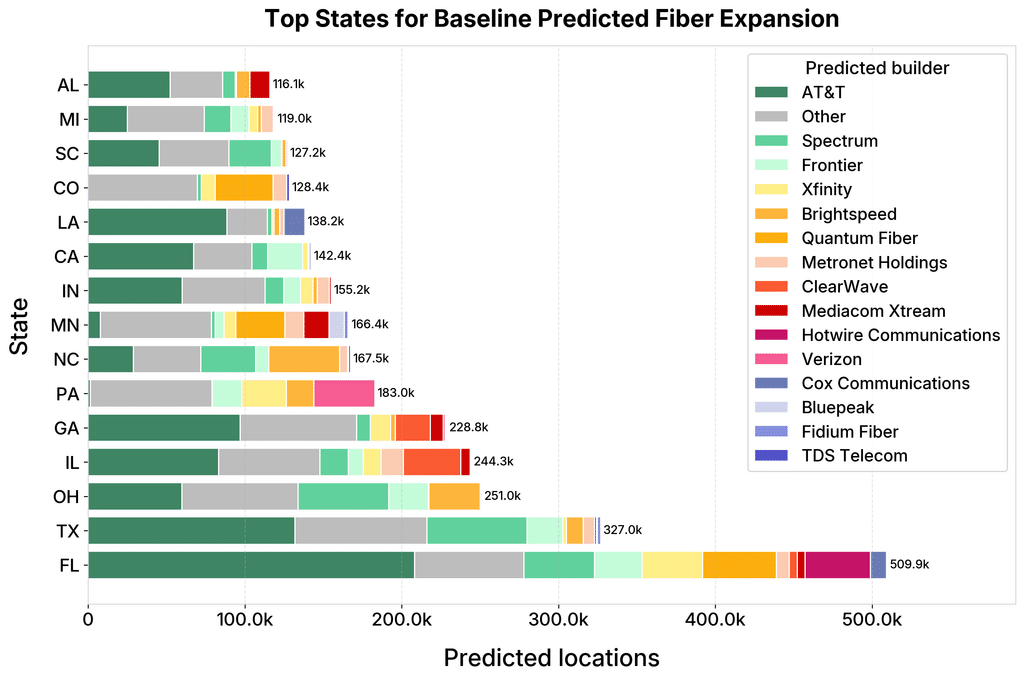
The Fiber Forecast Model identifies AT&T, regional ISPs and mid-sized providers as the leading drivers of near-term deployment, with Florida, Texas, Ohio, Illinois and Georgia emerging as the top growth states: high-growth, mixed-density markets where overbuild economics work best.
Click here to read the full Broadband in America Fixed Broadband Competition Focus Report—August 2026 edition.
This report will be updated twice a year when the latest data is released. If you have any questions, please contact [email protected].