
Cable operators’ number of fiber-served locations has grown 44.5%, while upgrades to existing hybrid fiber-coaxial (HFC) networks continue to play a role in network expansion strategy.
Cable operators are expanding fiber coverage while modernizing existing hybrid fiber-coaxial (HFC) networks that serve millions of homes and businesses. This monthly edition of CostQuest’s Broadband in America Report examines cable multiple system operators’ (MSOs) evolving role in U.S. broadband expansion and how local competition, customer demand and network economics shape fiber deployment and HFC upgrade decisions.
Cable operators’ growing fiber footprint—fiber-served BSLs now represent 14.9% of total operator footprint
Cable operators’ number of fiber-served BSLs grew 44.5% between FCC BDC and CostQuest’s Fabric Versions 5 and 8 (June 2024 to December 2025), reaching 14.93 million Broadband Serviceable Locations (BSLs). Fiber now represents 14.9% of the overall Cable MSO-served footprint, reflecting expansion trends in new-build areas and targeted overbuilds. Cable operators are growing their fiber presence while using upgraded HFC to provide higher speeds to serve much of their established footprint.
Competition shapes operators’ network expansion strategy and customer adoption
Cable operators’ fiber coverage is growing faster where another fiber provider is present, while take rates are higher in areas without another fiber competitor. These differences highlight why coverage growth and customer adoption both matter when evaluating market potential. For providers and investors, understanding the local competitive landscape can help put expansion opportunities and expected customer uptake into context.
Modernized HFC remains part of the high-speed broadband expansion and investment strategy
DOCSIS upgrades and other capacity improvements help existing HFC networks continue delivering high-speed broadband. Where network condition and capacity support expected demand, targeted modernization can preserve capital flexibility and improve service using existing infrastructure. Fiber deployment supports new construction and expansion, with targeted overbuilds offering another option where competition or network economics strengthens the investment case.
For operators, state broadband offices and investors, these trends underscore the value of a location-specific view of broadband deployment and investment behavior. Understanding where fiber expansion and HFC modernization fit local conditions can help inform decisions about service improvements and long-term network growth.
Read the full: Broadband in America Report: Cable’s Role in Broadband Expansion — October 2026 Edition.
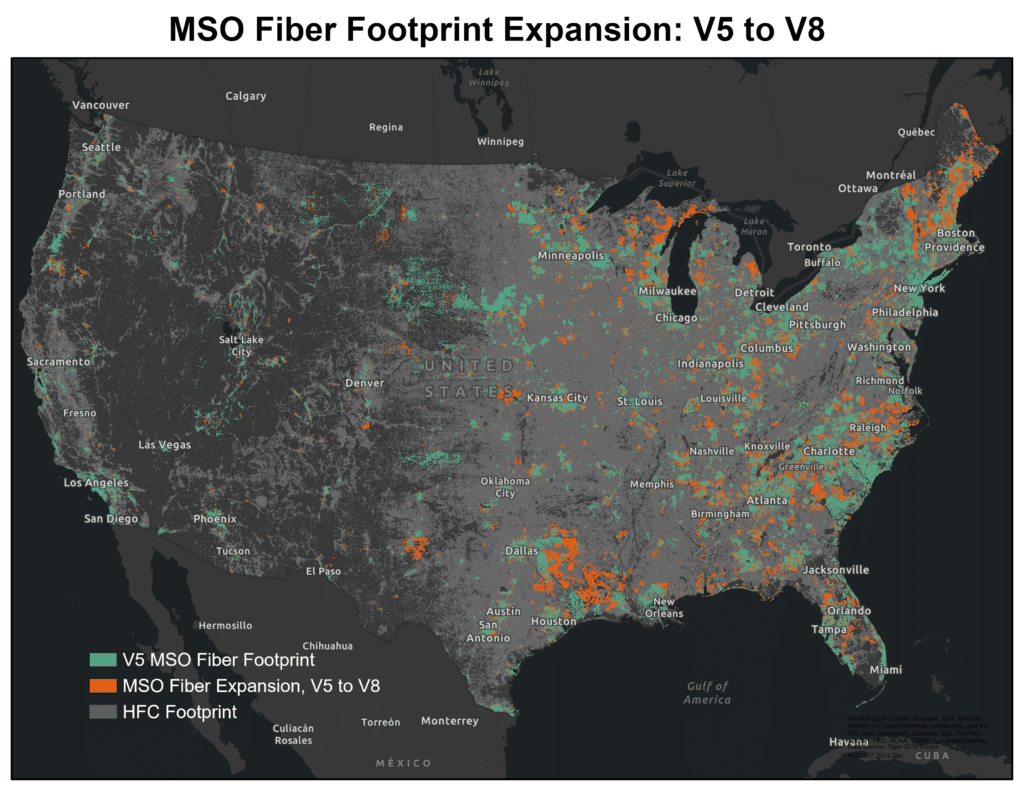
MSO’s fiber footprint growth from June 2024 to December 2025 (V5-V8): fiber-served BSLs in V5 (green), fiber expansion (newly fiber-served BSLs in V8) (orange) and HFC footprint in V8 (gray). Source: CostQuest Fabric & FCC BDC, V5–V8.
This report will be updated twice a year when the latest data is released. If you have any questions, please contact [email protected].