

Below is a quick breakdown of the key FCC BDC (Broadband Data Collection) Filing and USAC HUBB Filing deadlines, requirements, Location Fabric requirements, and other critical information to help you prepare your filings for these two federal reporting programs.
Click the link for 2025 FCC rule changes involving the use of the Broadband Serviceable Location Fabric Data for reporting on high-cost program progress via HUBB Filings, in addition to using the Location Fabric data for BDC Filings.
FCC BDC Filing Program
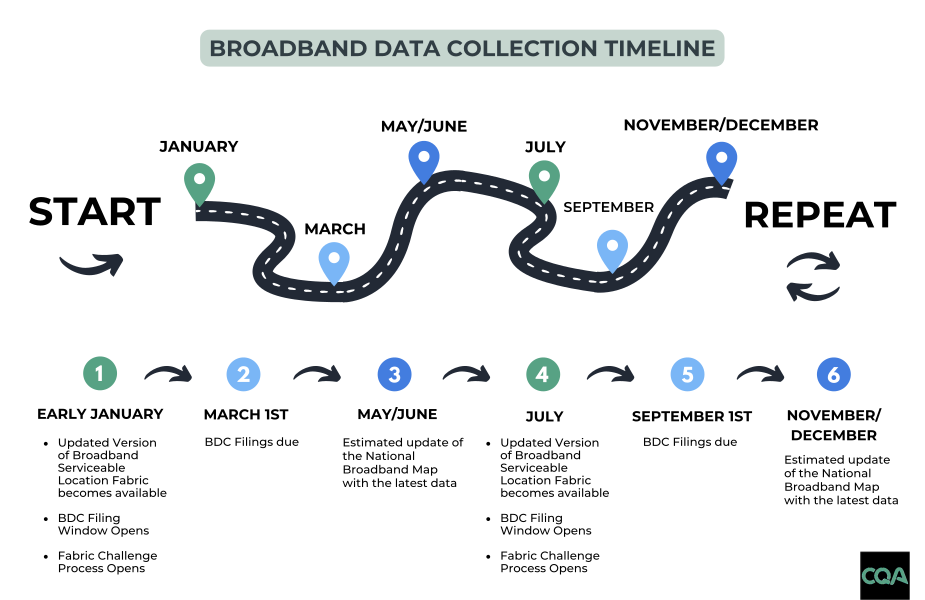
The Broadband Data Collection (BDC) program will supply the FCC, communications industry, state, local, and Tribal government entities, and consumers with the data tools they need to improve the accuracy of existing broadband maps. All facilities-based broadband providers are required to file data with the FCC twice a year. The FCC uses the BDC program’s Location Fabric and ISP service availability to create their National Broadband Maps.
FCC BDC Filing Guide:
USAC HUBB Filing Program
Providers participating in modernized funds must file deployment data with the High Cost Universal Broadband portal (HUBB), showing where they are building out mass-market, high-speed Internet service using CAF & RDOF support.
USAC HUBB Filing Guide:
Broadband Data Collection Filing information
FCC BDC Filing deadlines
March 2, 2026 & September 1, 2026
Facilities-based providers of fixed and mobile broadband Internet access who have one or more end-user connections in service as of December 31, 2025, must file into the Broadband Data Collection by March 1, 2026.
Facilities-based providers of fixed and mobile broadband Internet access who have one or more end-user connections in service as of June 30, 2026, must file by September 1, 2026.
How do I file?
- Go to the Broadband Data Collection system at https://bdc.fcc.gov/
- You will either submit data in the BDC system via file upload and/or web form or submit data using an Application Programming Interface (API).
- Visit the BDC System User Guide at https://us-fcc.app.box.com/v/bdc-filer-user-guide which contains instructions on how to use the optional API (application programming interface), and other technical assistance resources to assist filers.
Who has to file?
- Providers of fixed and mobile broadband Internet access who have one or more end users in service on June 30th and December 31st.
- If you are required to file FCC Form 477 you must also submit data to the BDC.
See more details for BDC filers.
Who else can file?
- Federal agencies, state, local, and Tribal governmental entities in charge of mapping or tracking broadband internet access service coverage in their areas, can submit verified availability data as of June 30th and December 31st.
- Third parties who want to submit verified broadband availability data as of June 30th and December 31st.
- These parties can also submit data as part of the BDC challenge and crowdsource processes.
What do I need to file?
At stated on the FCC’s Broadband Data Collection Information for Filers web page, any individual submitting information in the BDC system, either on behalf of a service provider
or as a governmental or third-party entity, must submit the following information about
themself and the entity for which they are submitting data:
- For BDC Filings, you need access to the Broadband Serviceable Location Fabric data for your reporting area, to be the location basis to overlay your service availability information upon. Click here to get access to the Location Fabric data for FCC programs.
- Each BDC filing must include information about the filer, broadband availability data (including supporting data), and – for broadband providers – Form 477 broadband subscription data.
- Fixed wireline and satellite broadband service providers must submit either polygon shapefiles or a list of locations that constitute the service area of the provider. See BDC Availability Data Specifications Section 6 for more info.
- Fixed wireless broadband service providers must submit either propagation maps and propagation model details or a list of locations that constitute the service area of the provider. See BDC Availability Data Specifications Sections 6 and 7 for more info.
- Mobile wireless broadband service providers must submit propagation maps and propagation model details for each network technology and both outdoor stationary and in-vehicle mobile network coverage. In addition, mobile wireless broadband service providers must also submit signal strength heat map data. See BDC Availability Data Specifications Sections 8 and 9 for more info.
- Fixed broadband service providers may now access the FCC’s Broadband Serviceable Location Fabric Data to match their availability data to the location IDs represented in the Fabric.
- If you are a provider of both broadband and voice services (a local telephone service provider, a facilities-based provider of mobile telephony service, or a provider of interconnected voice over internet protocol (VoIP) service – see https://us-fcc.app.box.com/v/WhoMustFileForm477 for descriptions and definitions of each provider type), you also must file your Form 477 fixed and/or mobile voice subscription data in the BDC system. See BDC Availability Data Specifications Section 5 for more info.
- Providers of mobile voice service must file BDC mobile voice availability data in the BDC system. See BDC Availability Data Specifications Section 8.2 for more info.
- Data specifications for primary availability BDC filings are available here:
https://us-fcc.app.box.com/v/bdc-availability-spec
FCC BDC Filing resources
For more resources on the FCC’s Broadband Data Collection, visit the Broadband Data Collection Help Center. If you have questions, email [email protected].
FCC BDC Filing sections by provider type
USAC HUBB Filing information
1. File deployment data into the HUBB – Submit served locations from the previous deployment year
2. Certify data by filing Form 481
3. Submit 54.314 certification
4. Submit performance measure testing
USAC HUBB Filing deadline
March 2, 2026
Participants in the following funding programs have until March 2, 2026, to file data for all locations deployed with CAF support in 2025 or certify that they have “no locations to upload.”
- Alternative Connect America Cost Model (Original ACAM)
- Revised Alternative Connect America Cost Model (Revised ACAM)
- Alternative Connect America Cost Model II (ACAM II)
- Connect America Fund Broadband Loop Support (CAF BLS)
- Rural Broadband Experiments (RBE)
- Alaska Plan
- Connect America Fund Phase II Auction (CAF II Auction)
- Rural Digital Opportunity Fund (RDOF)
- Bringing Puerto Rico Together (Uniendo a Puerto Rico) Fund and the Connect the USVI Fund (PR/VI)
USAC states, “Carriers with 2025 deployment milestones may face verification reviews tied to those milestones to confirm deployment to a random sample of reported locations in the months following the HUBB filing deadline. (Note that carriers with deployment milestones no longer need to complete separate milestone certifications as part of the annual HUBB filing. Starting with the March 2, 2026, filing window, the HUBB automatically completes milestone certifications – including separate milestone certifications for separate deployment obligations by speed tier – for carriers that certify enough locations.)”
Visit USAC’s website for more information about HUBB Regulatory Filing requirements.
Important FCC rule changes
The Broadband Serviceable Location Fabric Data is now required to be used or aligned with for reporting on high-cost program progress via HUBB Filings, in addition to using the Location Fabric data for FCC Broadband Data Collection (BDC) Filings.
How do I get access to the Location Fabric for FCC Programs?
To request access to the FCC’s Broadband Serviceable Location Fabric (Fabric) and start matching or aligning your service availability data to the Broadband Serviceable Locations in the Fabric, please contact [email protected].
For more information about the Location Fabric data, please visit the Broadband Serviceable Location Fabric Resource Center.
Disclaimer
This communication does not reflect the opinion of the Federal Communications Commission or Universal Service Administrative Co. (USAC). The FCC or USAC is not responsible for the information or views in this communication and is not responsible for the accuracy, completeness, or timeliness of such information or views.