

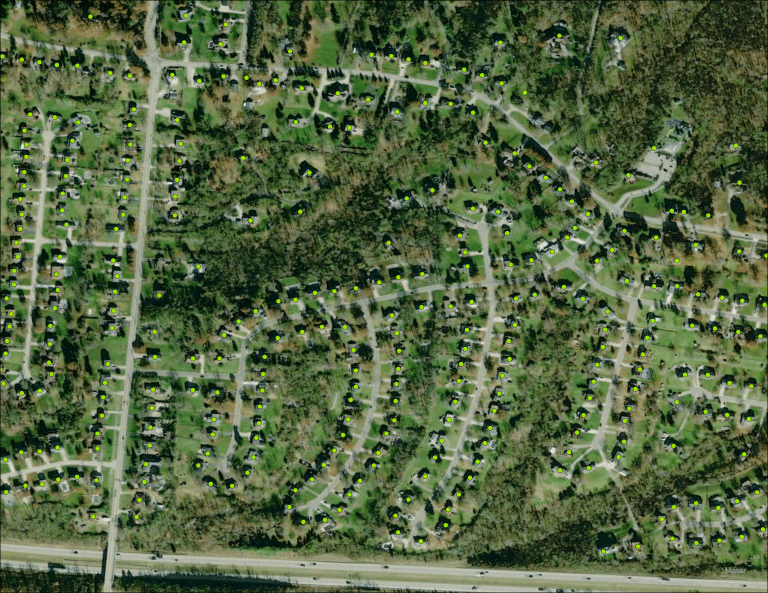
The National Broadband Serviceable Location Fabric is “a common dataset of all residential and business locations (or structures) in the U.S. where fixed broadband internet access service is or can be installed.” Each location in the Fabric is referred to as a Broadband Serviceable Location (BSL), and the definition of a BSL is established by the FCC. The Fabric is the foundational location database used across several government programs, including NTIA’s BEAD, the FCC’s Broadband Data Collection, National Broadband Maps, and others. CostQuest is the official contractor and provider of the National Broadband Serviceable Location Fabric data. The Fabric data is updated twice a year.
Fabric updates
Broadband Serviceable Location Fabric Version 8 Available
Fixed broadband service providers, government entities, and other designated entities are able to access Version 8 of the Broadband Serviceable Location Fabric (Fabric) to support the FCC’s Broadband Data Collection (BDC), and other select federal programs. The new version of the Fabric incorporates updated data sources and other improvements by the FCC and CostQuest, along with the results of Fabric challenges submitted through the National Broadband Map by state, local, and Tribal governments, broadband providers, and the public. Compared with prior versions, it adds Broadband Serviceable Locations and corrects addresses, unit counts, building types, land use classifications, and geographic coordinates. To be considered for the next Fabric update in June 2026, Fabric challenges must be submitted by March 2, 2026.
The Broadband Serviceable Location Fabric is the backbone of the FCC’s Broadband Data Collection (BDC) program and a critical tool for expanding high-speed internet nationwide. It is essentially a detailed, nationwide address list of broadband‑serviceable structures, with precise geographic coordinates. Fixed broadband providers use this baseline to attach their service availability data to the corresponding Fabric location points to create their BDC filings for the FCC. When combined with those provider submissions, the Fabric allows the FCC to build the National Broadband Map—showing exactly where broadband is available and, just as importantly, where gaps remain—so that the FCC, states, Tribes, local governments, and broadband stakeholders can target investments and deployment efforts to bring high-speed internet to unserved and underserved communities.
Click here for more information about the Broadband Serviceable Location Fabric licensing and data use rights.
Fabric FAQ
Visit the Broadband Serviceable Location Fabric FAQ for critical information and answers to common questions about the Fabric for federal programs.
Broadband Serviceable Location Fabric data sources and methodology
The data sources used to identify Broadband Serviceable Locations and the location information listed in the Fabric include a combination of:
- Parcels
- Satellite Imagery
- Building Footprints
- Address databases
- Land and Tax Attributes
- Roads
- Other sources necessary or beneficial for supporting the determination of the location of structures throughout the U.S. where fixed broadband service can be installed.
To learn more about the development methods for the National Broadband Serviceable Location Fabric, visit the Methods Manual linked below.
Video tutorials
Video Tutorials

Overview of Location Fabric Data Fields
Video Tutorials
FCC Location Fabric Video
Video Tutorials
FCC Location Fabric Bulk Challenge Process
Video Tutorials
BDC Technical Assistance: Filing Bulk Challenge Data
Have Questions?
Please email [email protected] for any additional questions regarding the NTIA Fabric License.
For questions regarding the Broadband Serviceable Location Fabric for the Broadband Data Collection, please email [email protected].
Disclaimer
This document does not constitute legal advice. CostQuest Associates cannot provide legal analysis for Licensees. We recommend that any questions or concerns be discussed with your legal counsel after review of the appropriate License Agreement.
This communication does not reflect the opinion or the policy of the Federal Communications Commission or NTIA. Neither agency is responsible for the information or views in this communication and neither are responsible for the accuracy, completeness, or timeliness of such information or views.