
Licensed fixed wireless emerges as a fast-growing, cost-effective broadband solution bridging gaps where fiber remains out of reach.
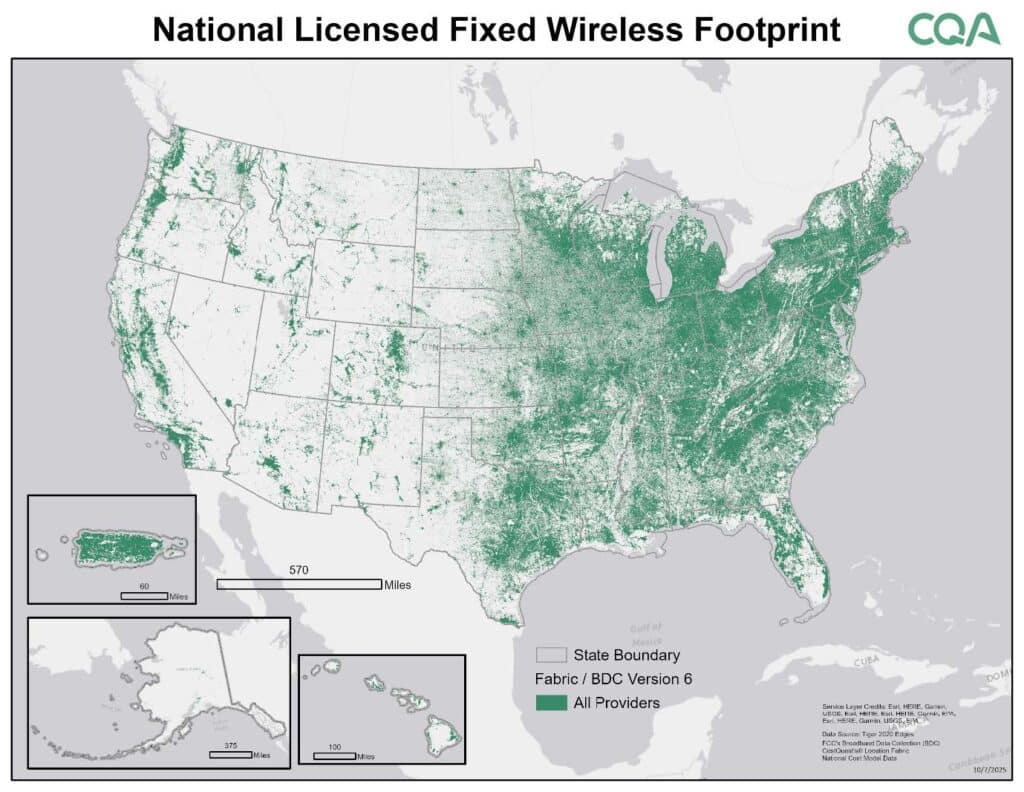
The licensed fixed wireless access (FWA) market has rapidly evolved from a rural connectivity solution to a mainstream broadband option competing directly with cable and, in some areas, fiber. This Broadband in America (BBIA) report examines the state of the licensed FWA market in the United States as of October 2025, drawing on the latest data from the FCC’s Broadband Data Collection (BDC) and CostQuest’s® Location Fabric and Network Cost Model (Version 5 and 6). The analysis focuses on licensed FWA and service definitions that follow the NTIA standard of offering download speeds of at least 100 Mbps, upload speeds of at least 20 Mbps, and latency suitable for real-time applications.
Report highlight: 145% increase in licensed fixed wireless access coverage
Nationwide, there has been a 145% increase in licensed fixed wireless access coverage since the first BDC release, with an additional 8.2% gain from Version 5 to Version 6 in just six months. This expansion reflects increased use of mid-band spectrum, 5G upgrades, and improved customer premises equipment. National mobile carriers such as Verizon, T-Mobile, and AT&T now dominate the market, while regional Wireless Internet Service Providers (WISPs) continue to primarily utilize unlicensed spectrum to provide service.
Economically, FWA is most cost-effective in areas where operators can leverage existing mobile infrastructure and spare capacity. Federal funding programs such as the Rural Digital Opportunity Fund (RDOF) and Broadband Equity, Access and Deployment (BEAD) program have also contributed to recent growth – particularly in rural areas – by incentivizing high-speed, low-latency technologies.
Looking ahead, FWA is expected to maintain its momentum in rural, suburban, and small-business markets where fiber deployment remains cost-prohibitive or delayed. Continued expansion will rely on strategic spectrum management, 5G-Advanced upgrades, and policies that balance innovation with sustainable growth.
While fiber continues to represent the long-term benchmark for broadband reliability and speed, fixed wireless has become a key component of the nation’s broadband ecosystem delivering rapid and flexible connectivity across the United States.
Click here to read the full Broadband in America Fixed Wireless Access Market Focus Report—November 2025 Edition.
This report will be updated twice a year when the latest data is released. If you have any questions, please contact [email protected].