
For over four decades, Joann Lawler didn’t just witness the transformation of American telecommunications, she helped shape it, one cost model at a time.
When Joann Lawler joined CostQuest Associates in 2014, she didn’t arrive as a newcomer to the field. She arrived as one of the most formidable telecom cost modeling experts in the country, a distinction she had earned over nearly four decades inside one of the most technically complex industries in the world.
1977: The beginning of an enduring career
Joann’s telecom journey began in 1977 when she accepted a position as an assistant engineer at New Jersey Bell. She was one of two women in an engineering group of nine. The telecom world she stepped into was entirely copper, entirely monopolized, and entirely analog in its thinking.
“When I started, we were rebuilding neighborhoods … it was still all copper,” Joann said. “Every house had service unless it was currently vacant. There was no competition. It was a monopoly.”
From copper to fiber, four decades of change
In the decades that followed, Joann moved steadily through the ranks at New Jersey Bell – which would eventually become Verizon – navigating one of the most turbulent periods of transformation the telecom industry has ever seen. The 1984 AT&T divestiture reshaped the entire regulatory and financial landscape of American telecommunications, and Lawler was in the middle of it, working on revenue requirement studies and carrier access billing systems.
By the late 1980s and into the 1990s, she had moved to Philadelphia, building the kind of deep, multilayered expertise that could only come from years of hands-on work across nearly every dimension of a telephone network’s cost structure. She also witnessed the first in-service fiber cable deployment in her district, and when she asked her manager how long it would be before fiber reached the loop plant, she was told flatly, ‘that’s never going to happen.’
It was that kind of first-hand experience, watching predictions fail and adapting in real time, that shaped Joann into the expert she would become.
Work that made others take notice
By the late 1990s, Joann was doing something that very few people in the industry were doing. She was climbing through Verizon’s pair assignment systems (massive databases tracking every copper pair in a network) and using them to build cost models of extraordinary detail and accuracy.
Mark Guttman, Vice President and Chief Solutions Officer at CostQuest Associates, described it vividly, “Think of a needle in a haystack,” he said. “You’d have these huge 3,000-pair copper cables … she was hopscotching – walking the tree from the customer premise all the way back through every cross-connect. That was really, really novel to us.”
CostQuest’s CEO and Founder, Jim Stegeman, had experienced her expertise firsthand when his consulting firm attempted to sell Verizon on a new cost model. Every time they presented, Joann was in the room. “Joann asked excellent questions, probing,” Stegeman said. “If you weren’t prepared, you could stumble. If she was in the crowd, I was always concerned about what she might ask, just because I was not sure if I would be able to answer.”
The telecom pioneer
The club of cost modeling was already small, but the number of women operating at Joann’s technical level was smaller still.
“What was really rare was a woman engineer or technical expert – Joann was pretty … the difference between rare and unique,” Guttman said. “There were probably handfuls that I could remember within that cost group of several hundred people.”
She navigated that reality not by drawing attention to it, but by being so thoroughly excellent that it became beside the point. By 2014, she had helped Verizon build some of the most sophisticated cost models in the industry, including playing a direct role in the early cost planning for Fios, Verizon’s landmark fiber-to-the-home buildout that began in 2005.
2014: An easy decision
In 2014, Verizon decided to close its Philadelphia office. Joann was offered a relocation to Texas. She declined. Instead, she sent Stegeman an email: Can you use an analyst? “There was really no decision to be made,” he said. “It was kind of a no-brainer. We were surprised Verizon was getting rid of, or made the offer to allow her to leave.”
Her arrival didn’t just add capacity. It added a level of technical expertise the company hadn’t previously had access to.
“Gaining the skill that she had in outside plant was huge,” Guttman said. “She helped us to significantly change the way CostPro was operating in the way it was calculating investment. That was a huge gain for us from the onset.”
In Joann’s own words: “Working with the programs and trying to improve the investment module, trying to separate the material from the labor and other costs … I wanted to be able to get more quantities and more detail out of there. I think the way it’s built now, you can get into excruciating detail if you need to.”
The key cog in the wheel
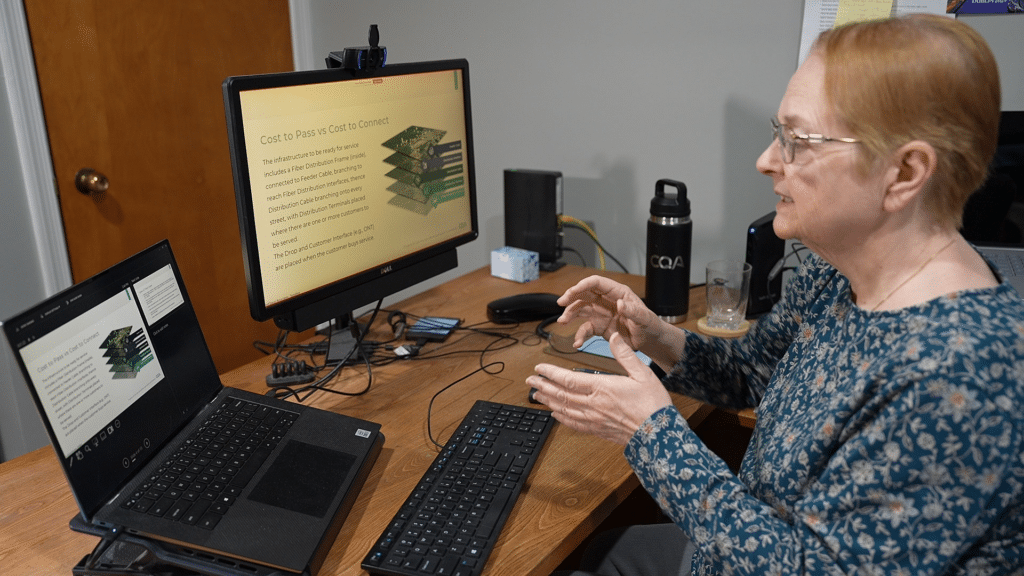
From 2014 onward, Joann became the quiet backbone of CostQuest’s most technically demanding work, taking over portions of the modeling Jim had previously handled himself and bringing a level of engineering sophistication that neither Jim nor Mark could fully replicate. “She has an engineering background. I’m not an engineer. Jim wasn’t an engineer,” Guttman said. “She could bring that level of technological sophistication up.”
She also pushed the team intellectually: bringing in books on routing theory, driving geospatial work, and opening new lines of business the company couldn’t have pursued without her. Even after officially retiring, she was brought back as a subcontractor; her expertise too valuable to let go.
“Joann is that key cog in the background,” Stegeman reflected. “She just puts her head down, and gets things done – educates others and really provides the information we need to thrive in what we do on the costing side.”
When asked how you replace someone like Joann, Guttman was blunt: “You’re not going to replace Joanne, right? That’s like, impossible.”
She began her career in 1977 in a copper world with no competition and no fiber. She ended it having helped shape the cost modeling frameworks that inform how billions of dollars in telecom infrastructure –mostly fiber – are valued, regulated, and built today.